
The fuel in your tank has quietly changed. Since the nationwide E20 mandate came into force in April 2026, every litre of petrol dispensed at pumps across India now contains 20% ethanol. You may not have noticed — or you may be one of the many drivers asking why your mileage has shifted slightly.
Either way, there’s real science happening inside your engine every time you fill up with E20. And understanding it will help you make smarter decisions about your vehicle, your maintenance schedule, and what to expect from the road ahead.
Let’s get into it.
Table of Contents
First: What Makes E20 Chemically Different from Regular Petrol?
To understand how E20 affects your engine, you first need to know what ethanol actually is at a molecular level — and how it differs from petrol.
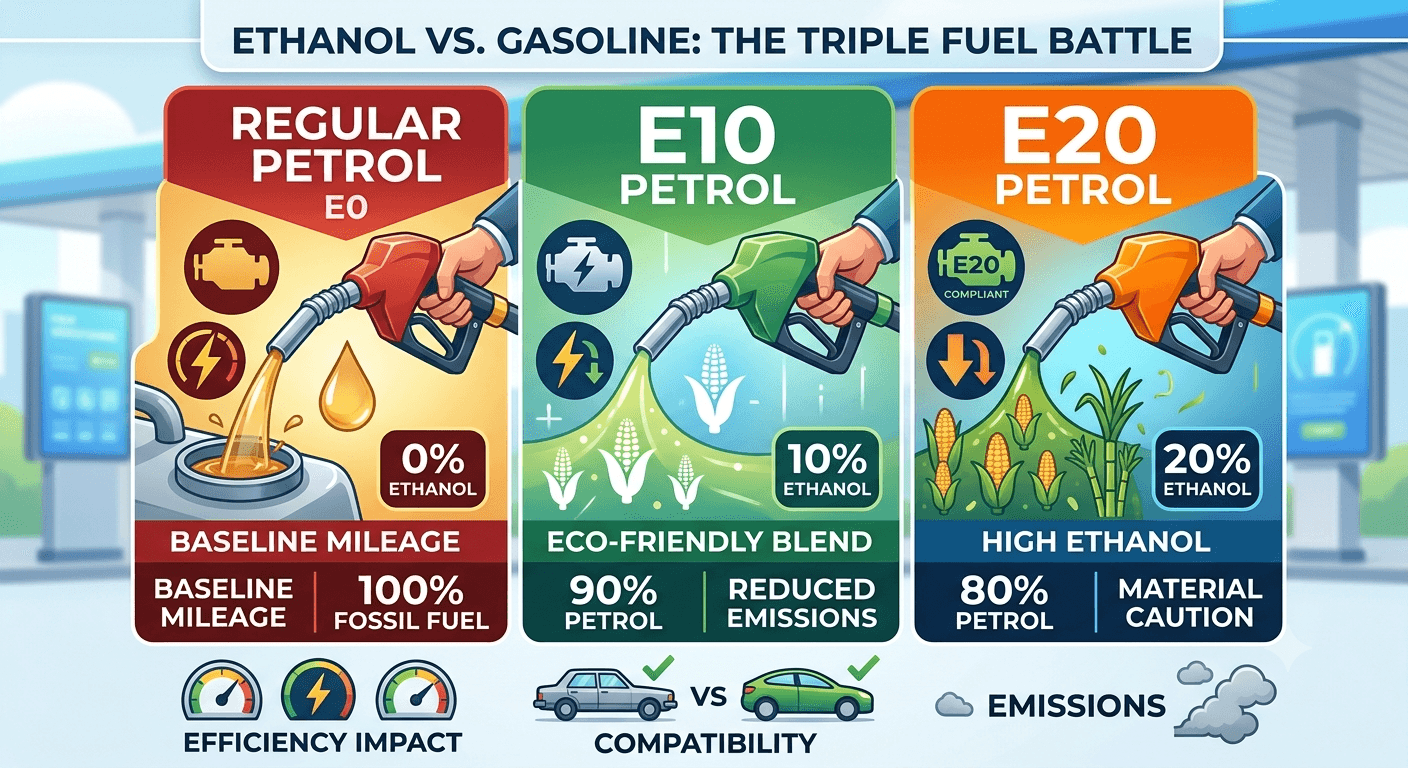
Conventional petrol is a mixture of hydrocarbons — molecules made purely of hydrogen and carbon atoms. Ethanol (C₂H₅OH), by contrast, is an oxygenated fuel. It contains oxygen in its molecular structure. This single difference has a chain of consequences that ripple all the way through your engine’s behaviour.
Here’s a comparison of key fuel properties:
| Property | Petrol (E0) | Ethanol | E20 Blend |
|---|---|---|---|
| Energy Content (MJ/litre) | ~31.5–32 | ~21.1 | ~29.5–30 |
| Octane Rating (RON) | 88–91 | ~108 | 95+ |
| Oxygen Content | None | ~34.7% | ~7% |
| Stoichiometric Air-Fuel Ratio | ~14.7:1 | ~9:1 | ~13.8:1 (interpolated estimate) |
| Flame Speed | Moderate | Higher | Slightly higher |
| Hygroscopic? | No | Yes | Slightly |
Note: The E20 stoichiometric ratio of ~13.8:1 is an interpolated estimate based on verified values for petrol (14.7:1) and pure ethanol (9:1). No single authoritative published figure for E20 specifically exists, as the exact value varies slightly with fuel composition.
Two numbers stand out immediately: the lower energy content and the higher octane rating. These two properties pull in opposite directions — and how your specific engine handles that tug-of-war determines your real-world experience with E20.
What Happens Inside Your Engine When You Burn E20?
Step 1: Fuel Injection and the Air-Fuel Mix
Your engine runs by burning a precise mixture of air and fuel. For regular petrol, the ideal air-to-fuel ratio (known as the stoichiometric ratio) is about 14.7 parts air to 1 part fuel. For ethanol, this ratio drops to about 9:1, because ethanol contains its own oxygen — meaning it needs less air from outside to complete combustion.
E20 sits in between, at roughly 13.8:1 (an interpolated estimate — no single published standard exists for E20 specifically). The oxygen already present in the ethanol makes the mixture slightly leaner than regular petrol at the same injection volume.
In a modern car with Electronic Fuel Injection (EFI) and an Engine Control Unit (ECU), this is automatically compensated for. The ECU continuously reads data from the oxygen sensor (lambda sensor) in the exhaust and adjusts the amount of fuel injected to maintain the correct burning ratio. When it detects a leaner mixture from the ethanol, it adjusts injector pulse width accordingly — restoring near-optimal combustion.
In older carburetted engines, no such automatic adjustment exists. The carburettor delivers a fixed fuel-air ratio, which means ethanol’s oxygen contribution throws the mixture off — and no one corrects it.
Step 2: Combustion and the Octane Advantage
Here’s where E20 actually has an edge over older regular petrol.
Octane rating measures a fuel’s resistance to engine knock — that rattling or pinging sound caused by the fuel igniting too early before the piston reaches the correct position. Knocking is bad for engines: it causes power loss, heat buildup, and long-term damage.
Regular petrol sold in India has historically had a RON (Research Octane Number) of around 88–91. E20, as mandated by the government, must meet a minimum of RON 95 — a meaningful jump. Pure ethanol itself has an octane rating of around 108 RON, and even at a 20% blend, it pushes the overall octane level up significantly.
What this means in practice:
- Better knock resistance — the fuel withstands compression more stably
- The ECU can advance ignition timing — firing the spark plug slightly earlier to extract more energy from each combustion cycle
- Turbocharged engines benefit the most — turbo engines operate under higher cylinder pressures, making knock resistance especially valuable. Vehicles like the Hyundai Creta N Line or Skoda Kylaq, with their turbocharged engines, can leverage the higher octane rating of E20 for marginally better power output
This is the octane advantage, and it partially offsets E20’s lower energy content — particularly in engines tuned to take advantage of it.
Step 3: The Energy Density Trade-Off
Here’s the unavoidable physics. Ethanol contains roughly 21.1 megajoules of energy per litre, compared to petrol’s 31.5–32 MJ per litre. That’s about 67% of petrol’s energy per litre.
At a 20% blend, E20 carries approximately 94–95% of petrol’s energy content. In theory, this should cause a 5–6% drop in mileage. In practice, the ECU’s compensation and the octane benefit bring that loss down — but not to zero.
Real-world mileage tests conducted by Autocar India on four E20-compatible vehicles produced in 2024–25 found the following drops when switching from E10 to E20:
- Maruti Suzuki Dzire (1.2L naturally aspirated): 3.8% drop
- Tata Punch (1.2L naturally aspirated): 8.3% drop
- Skoda Kylaq (1.0L turbo): 5.5% drop
- Hyundai Creta N Line (1.5L turbo): 12.6% drop
The average across vehicles lands in the 6–8% range for E20-compliant cars, though ARAI estimates a slightly more conservative 1–6%. For older, non-E20-tuned vehicles, experts peg the efficiency loss at 7–8% or more.
To put that in practical terms: if your car gives 15 km/litre on regular petrol, you’re likely to see 13.5–14 km/litre on E20 — a difference of roughly 1–1.5 km per litre under normal city driving conditions.
The ECU: Your Car’s Silent Adaptor
The unsung hero of E20 compatibility is the Engine Control Unit (ECU) — the onboard computer that manages fuel injection, ignition timing, and dozens of other parameters in real time.
In a modern BS6 engine with closed-loop fuel injection, the ECU monitors oxygen sensor feedback, detects the altered combustion characteristics of ethanol, and continuously adjusts to maintain optimal performance. This is why the real-world mileage drop is 6–7% rather than the theoretical 10–11% that raw energy math would predict.
However, this adaptive capability has limits. The ECU can compensate within a calibrated range. If your vehicle was designed and calibrated for E10 (or even E5), the ECU’s adaptation range may not fully cover E20’s requirements. This is why:
- BS6 Phase 2 vehicles (manufactured from April 2023 onwards) are fully E20-compliant — their ECUs are calibrated specifically for E20
- BS6 Phase 1 vehicles (2020–2023) can typically handle E20 safely, though some may benefit from an ECU software update
- Older carburetted or pre-BS6 vehicles rely on fixed fuel-air ratios with no electronic adaptation — making them the most vulnerable to E20’s effects
What E20 Does to Your Fuel System Components
Beyond combustion, the 20% ethanol content affects other parts of your car’s fuel system — and this is where older vehicles need to pay close attention.
Rubber and Polymer Components
Ethanol is a stronger solvent than petrol. It can degrade certain types of rubber hoses, O-rings, seals, and gaskets over time — particularly those made from natural rubber or early-generation synthetic materials. Modern fuel systems use ethanol-resistant materials (fluorinated rubber, Viton, stainless steel), but vehicles manufactured before 2009 or so may have components that weren’t designed with high-ethanol blends in mind.
A LocalCircles survey of over 37,000 petrol vehicle owners across 331 districts found that 28% of owners with pre-2022 vehicles reported unusual wear and tear or repair needs in August 2025 after E20 became the standard fuel — affecting fuel lines, tanks, and carburettors. By October 2025, a follow-up survey of 36,000 owners found that figure had risen sharply to 52%, suggesting component degradation was accelerating as continued E20 use took its toll on older vehicles.
Moisture Absorption (Hygroscopic Behaviour)
Ethanol is hygroscopic — it attracts and absorbs water from the atmosphere. This can lead to:
- Water contaminating the fuel-air mixture, causing rough idling or difficult cold starts
- Corrosion in metal fuel tanks and components over time
- Phase separation in the fuel tank if the vehicle sits unused for extended periods with a low fuel level
The practical advice: keep your fuel tank reasonably full if parking for more than a few days, especially in humid climates.
Fuel Injectors
Ethanol’s solvent properties can loosen deposits inside fuel injectors. In the short term, this can actually clean injectors that had built-up residue. Over the longer term, ethanol can cause accelerated wear in injectors not designed for it. Modern direct-injection engines use ethanol-compatible injector materials.
How E20 Performs Differently: Petrol, Turbo, and Older Engines
Modern Naturally Aspirated Engines (BS6 Phase 2)
These are the sweet spot for E20. ECUs calibrated for the blend handle fuel mixture adjustments automatically. Expect a 3–6% mileage drop from E10 levels, good knock resistance, and smooth combustion. No material concerns.
Turbocharged Engines
Turbo engines are more sensitive to fuel octane because they compress the air-fuel mixture further before ignition. The RON 95 minimum of E20 is actually beneficial here — providing better knock resistance than old RON 91 petrol. Some turbo engines may deliver marginally better power output. The trade-off is that some turbocharged cars showed higher mileage drops in real-world tests (as with the Creta N Line above), partly because they were getting more from the higher-octane E10 baseline.
Older Carburetted and Pre-BS6 Engines
This is where E20 causes the most concern. Without electronic fuel management, the engine cannot adapt to ethanol’s different air-fuel requirements. Combined with older rubber components that may not be ethanol-resistant, the risk of performance issues and component wear is real. If your vehicle falls in this category, it’s worth speaking to a mechanic about inspecting fuel system components.
Will E20 Damage My Engine? The Honest Answer
For E20-compliant vehicles — essentially all cars manufactured from April 2023 onwards — the short answer is no. These vehicles are designed, calibrated, and built with materials specifically rated for E20. Engine damage is not expected.
For vehicles manufactured between 2020 and 2023 (BS6 Phase 1), the risk is low but not zero. The engine can handle E20 safely in most cases, but a check of rubber components and an ECU update (where available from the manufacturer) is advisable.
For pre-BS6 or pre-2020 vehicles, especially those with carburettors, the risks are more tangible: possible fuel system component degradation, rough performance, and mileage loss. These vehicles were never designed for E20 and the nationwide mandate has created a real challenge for their owners.
6 Practical Tips to Get the Best out of E20
- Check your owner’s manual — it will clearly state the ethanol blend level your vehicle is rated for. If it says E10, you’re in BS6 Phase 1 territory; if it says E20, you’re set.
- Maintain your tyre pressure — correctly inflated tyres are one of the biggest factors in real-world mileage. A slight energy loss from E20 is further compounded by underinflated tyres.
- Service regularly and on schedule — spark plugs, fuel filters, and injectors are more important with E20. Ethanol’s solvent properties mean these components benefit from timely servicing.
- Avoid long fuel tank layups — if your car sits unused for more than a week, keep the tank at least half full to reduce moisture absorption by the ethanol.
- Drive smoothly — gradual acceleration, anticipating braking, and avoiding unnecessary idling help offset the mileage difference from E20.
- Inspect older rubber components — if your vehicle is older, ask a mechanic to check fuel hoses, O-rings, and seals for early signs of ethanol-related degradation at your next service.
The Bottom Line: E20 Is a Trade-Off Your Car Can Handle
E20 petrol is not a perfect fuel. It has less energy per litre than straight petrol, and older vehicles face compatibility challenges that can’t be wished away. These are real trade-offs.
But the technology in modern engines — particularly the ECU-managed closed-loop fuel systems in BS6 vehicles — is designed to absorb most of those trade-offs automatically. For the majority of drivers in cars made after 2023, E20 delivers clean combustion, better knock resistance, and a mileage difference that amounts to a few extra kilometres of range lost per tank.
For a country trying to cut billions in crude oil imports, reduce urban air pollution, and build a sustainable energy future, that’s a trade-off worth making — even if it costs you a litre or two every thousand kilometres.
Planning to buy a new car? Read our next post: Is Your Car Compatible with E20 Petrol? Full List of E20-Ready Vehicles in India.
Tags: E20 petrol engine effect, E20 mileage loss, how E20 fuel works, ethanol combustion India, E20 compatible vehicles, ECU E20 adaptation, BS6 E20 cars



2 thoughts on “E20 Fuel Explained: How 20% Ethanol Changes the Way Your Car Runs”