
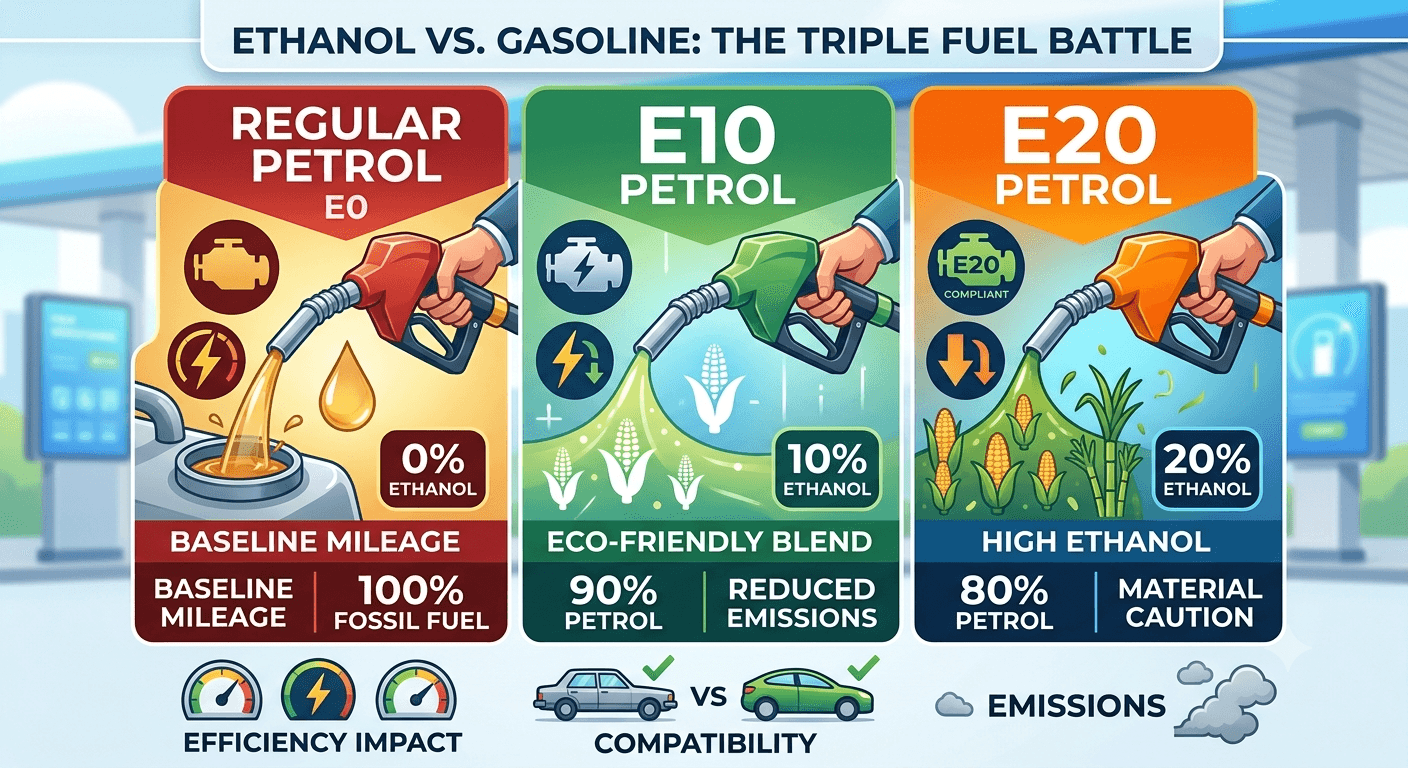
The primary difference between Regular Petrol (E0), E10, and E20 comes down to ethanol concentration — specifically, the percentage of renewable ethyl alcohol blended into refined petroleum.
While pure petrol contains 0% ethanol, E10 contains 10% ethanol, and E20 contains 20% ethanol. This shifting ratio impacts engine performance, fuel efficiency, material durability, and emissions.
Table of Contents
Technical Comparison Matrix
| Property | Regular Petrol (E0) | E10 Petrol | E20 Petrol |
| Ethanol Content | 0% | 10% | 20% |
| Petroleum Content | 100% | 90% | 80% |
| Energy Density | ~33.7 MJ/L | ~32.4 MJ/L (~3.8% drop) | ~31.1 MJ/L (~7.7% drop) |
| Average Efficiency Drop | Baseline | ~1.5% to 2% | ~3% to 5% |
| Octane Rating (RON) | Standard (~91 RON) | Slightly Higher (~92–93) | Higher (~93–95) |
| Water Sensitivity | Very low | Moderate (hygroscopic) | High (hygroscopic) |
| Engine Compatibility | All petrol engines | Vehicles built post-2010 | Vehicles built post-2023 (E20-compliant) |
1. Energy Density and Fuel Efficiency
Pure ethanol contains roughly 33% less energy per unit volume than pure gasoline. Because ethanol yields lower energy during combustion, higher blending ratios directly affect fuel economy:
- Regular Petrol (E0): Offers the highest energy density per liter, delivering the baseline fuel mileage specified by vehicle manufacturers.
- E10: Causes a minor drop in distance per liter (around 1.5–2%), which is barely noticeable during standard daily commuting.
- E20: Results in a noticeable decrease in fuel economy (3–5% drop). Because the engine requires slightly more fuel volume to generate the same combustion energy, you will notice marginally lower range per tank.
2. Chemical Properties: Moisture & Solvent Behavior
Ethanol is hygroscopic, meaning it naturally attracts and absorbs moisture from ambient air. It also functions as a powerful solvent.
- Phase Separation: If E10 or E20 sits in a fuel tank or storage vessel for an extended period, the ethanol can absorb enough humidity to separate from the petrol, creating a water-ethanol layer at the bottom of the tank. This layer can cause misfires or prevent the engine from starting altogether.
- Cleaning Action: Ethanol strips varnish and rust deposits from older fuel lines and tanks. In vintage or unmaintained fuel systems, these loosened deposits can quickly clog fuel injectors or carburetor jets.
3. Material Compatibility and Engine Wear
Ethanol reacts aggressively with certain metals, plastics, and non-resistant rubbers:
- Legacy & Non-Compliant Engines: In older vehicles, prolonged exposure to E20 causes classic rubber fuel hoses to degrade, crack, or swell. It can also corrode brass components, zinc alloys, copper, and uncoated steel fuel tanks.
- E20-Compliant Engines: Modern vehicles (especially those built to meet recent emissions standards like BS6 Phase 2 or post-2023 global standards) utilize synthetic elastomers like Viton for seals and lines, corrosion-resistant fuel injectors, and coated metal alloys specifically engineered to handle up to 20% ethanol safely.
4. Octane Rating and Anti-Knock Performance
Pure ethanol boasts an exceptionally high Research Octane Number (RON) of approximately 108.
When blended into standard base petrol, ethanol raises the overall octane rating of the mixture. Higher octane ratings increase the fuel’s resistance to “engine knock” (pre-ignition), allowing modern engines with higher compression ratios or turbochargers to advance ignition timing for smoother high-rpm performance.
Environmental and Macroeconomic Impact
- Tailpipe Emissions: Ethanol blends burn cleaner than pure fossil fuels, releasing lower levels of carbon monoxide (CO), unburnt hydrocarbons (HC), and particulate matter.
- Lifecycle Carbon Footprint: Because bioethanol is distilled from agricultural crops (such as sugarcane, corn, or surplus food grains), the plants absorb carbon dioxide during growth, lowering net lifecycle greenhouse gas emissions.
- Energy Security: High-blend fuels like E20 reduce a country’s reliance on imported crude oil by replacing 20% of foreign petroleum imports with domestically produced biofuels.



One thought on “The Fuel Mystery Solved: E10 vs. E20 vs. Regular Petrol Explained”